UGC NET Modern History Notes PDF: Every Chapter Tied to PYQs
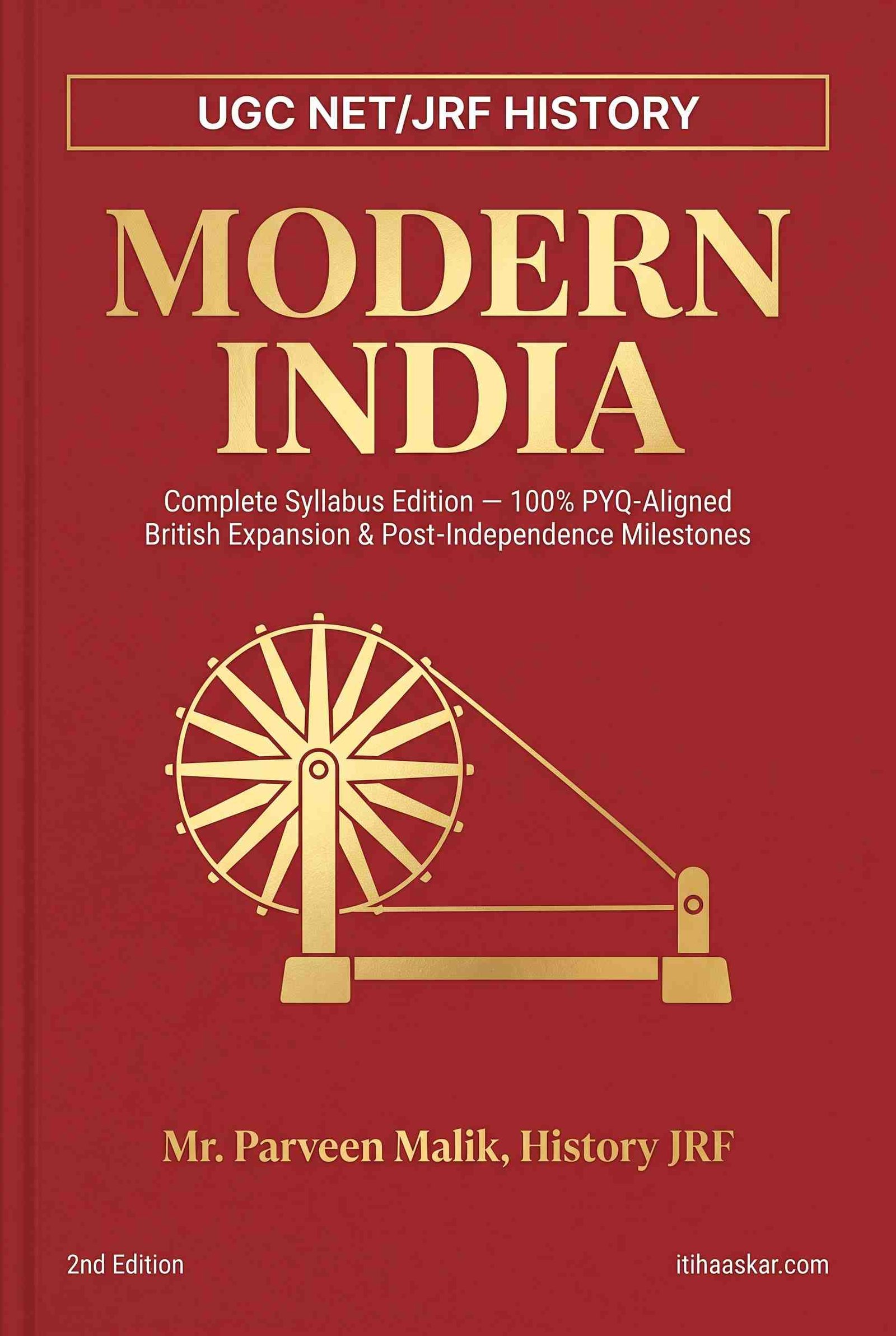
UGC NET History Modern India notes cover Units 7, 8 & 9 of the Code 06 syllabus: 15 chapters, 242 pages, with 90+ previous year questions linked to the chapter they came from. Read a free sample before you pay.
English edition · PDF · 242 pages
What’s inside
- Read a free sample in your browser before you pay anything.
- Every act, session and reform dated precisely — the exact detail statement-based questions test.
- Every leader cross-referenced to the exact PYQ that actually tested them.
- Built specifically for this era’s trickiest trap — near-identical dates and names that examiners love to swap.
- 1857 to 1947, with every act, movement and leader in one continuous story.
How it works
Mapped to Real PYQs
Every chapter is checked against actual previous-year questions, so you study exactly what gets asked.
Choose English OR Hindi (separate editions)
English and Hindi are two separate editions — pick the one you study in at checkout. Each purchase includes the PDF in that one language only; the other language is bought separately.
Instant Download After Purchase
A real download link arrives the moment payment clears, and stays available in your account permanently.
Complete Chapter List — 15 Chapters
- 1Advent of European Colonialism
- 2British Land Revenue Systems
- 3Colonial Economic Policies
- 4Constitutional Acts, 1773–1919
- 5Government of India Act 1935 & Independence
- 6Revolt of 1857
- 7Socio-Religious Reform Movements
- 8Press & Education Policy
- 9Rise of Nationalism & the INC
- 10Revolutionary Movements
- 11Gandhian Era
- 12Peasant & Tribal Movements
- 13Communalism & Partition
- 14The Bengal Famine of 1943 and India's Wartime Crisis
- 15Appendix — Modern India Reference Compendium

“I wrote these notes the way I wish someone had written them for me — chapter-wise, every PYQ placed where it belongs. If the file isn’t what I promised, write to me within 3 days for a full refund.” — Mr. Parveen Malik, History JRF
See a Free UGC NET History Modern India Sample Before You Buy
Read sample pages from this subject right in your browser.
What Modern India students say
“Verified purchase” means we have confirmed that this person bought the notes.

“The Historiography module finally made the Annales and Subaltern schools click for me. I cleared JRF in my very first attempt, and these notes were a big part of why.”
“Main abhi M.A. History second year mein hoon. Ye notes semester exams aur NET dono ke liye ek solid base de rahe hain — alag-alag jagah se padhne ki zaroorat hi nahi padti.”
“Ancient India was my weakest area for two attempts. The way the sources and historiographical debates are laid out here made it my strongest section in the actual paper. Cleared JRF this time.”
“Abhi NET ki taiyari kar raha hoon. Pehli baar Historiography aur Art & Culture jaise tough sections bhi manageable lag rahe hain. PYQ tagging se saaf pata chalta hai kya zaroori hai.”
“Hindi medium se hoon, par kabhi dikkat nahi aayi. Hindi notes ke terms bilkul clear the. NET qualify kiya, ab JRF ki taiyari kar rahi hoon inhi notes se.”
“Bundle liya tha — har rupaye ka paisa vasool. Coaching ke handouts se kahin zyada organised aur deep hai. JRF author ka farak saaf dikhta hai. NET aur JRF dono cleared!”
“I cleared my UGC NET in the latest June 2026. Im happy that i checked out these notes. Next time i'll try for JRF with the notes.”
Studied with Itihaaskar? Share your experience
Log in to leave a review and help other aspirants choose with confidence.
Log in to leave a reviewFrequently asked questions
Does this cover the freedom struggle and post-independence India?
Yes — from the Revolt of 1857 through the Gandhian movements and partition to post-independence India up to the LPG reforms.
Are the notes two-format?
Yes — English and हिंदी, switchable with the toggle above, which also sets your purchase language.
Will these help for other History exams?
Yes — Modern India is core for UGC NET, Assistant Professor and TGT/PGT History exams.
Which Modern India topics are highest-weightage?
The Revolt of 1857, the colonial economy and drain of wealth, and the Gandhian mass movements recur most in PYQs.
Which UGC NET units does Modern India cover?
Units 7, 8 and 9 of the UGC NET History (Code 06) syllabus — colonialism and economic policy, the Revolt of 1857, reform movements, and the freedom struggle through 1947.
Want the full 1757-to-1947 story laid out first? See our free guide:
Modern India — Colonialism to Independence, the free guide →You just bought the depth. Add the condensed revision notes for the same subject — this is what you'll actually reread the night before, not the full notes again.
Free, complete overview notes for every unit of this subject
Read the free unit complete overview notes first, then see what the full notes add in depth.
- Unit 7: Sources of Modern Indian History 8 topics
- Unit 8: Colonial Economy 11 topics
- Unit 9: Rise of Indian Nationalism 11 topics
How you get your notes (about a minute)
- Choose and paySecure payment by UPI, card or net banking (Knit Pay).
- Get access instantlyA receipt email with your download link arrives at once (check Spam/Promotions too). The same files stay in your free account dashboard under “My notes” for good.
- Download and studyThe PDF opens on any phone, tablet or computer. Download it again whenever you need.
A problem with the file? Email us within 3 days and we will fix or replace it. Read the refund policy
Is this right for you?
This is for you if…
- you are preparing for UGC NET/JRF History (Code 06) and want one syllabus-mapped source
- you learn best from structured, chapter-wise notes with PYQs mapped to them
- you want to read in Hindi or English, your choice
- you have only weeks left and need to cover the syllabus efficiently
Probably not for you if…
- you want live classes or doubt sessions (these are notes, not coaching)
- you want a guarantee of selection (no notes can promise that)
- you need notes for a subject other than History (these cover History only)
- you need a printed book (these are digital PDFs)
Your complete Modern India toolkit
Everything to study, revise and practise Modern India — in one place.
Check yourself: 3 quick questions
Test what you just read. When you are logged in, your first correct answer to each question earns XP.
Q01. The Doctrine of Lapse is associated with which Governor-General?
Dalhousie annexed states such as Satara, Jhansi and Nagpur by lapse.
Q02. Gandhi's first satyagraha in India (1917) was at:
Champaran was against the compulsory indigo cultivation (tinkathia system).
Q03. The Cabinet Mission of 1946 proposed:
Its plan envisaged groups of provinces under a weak Union; it was ultimately not implemented.