
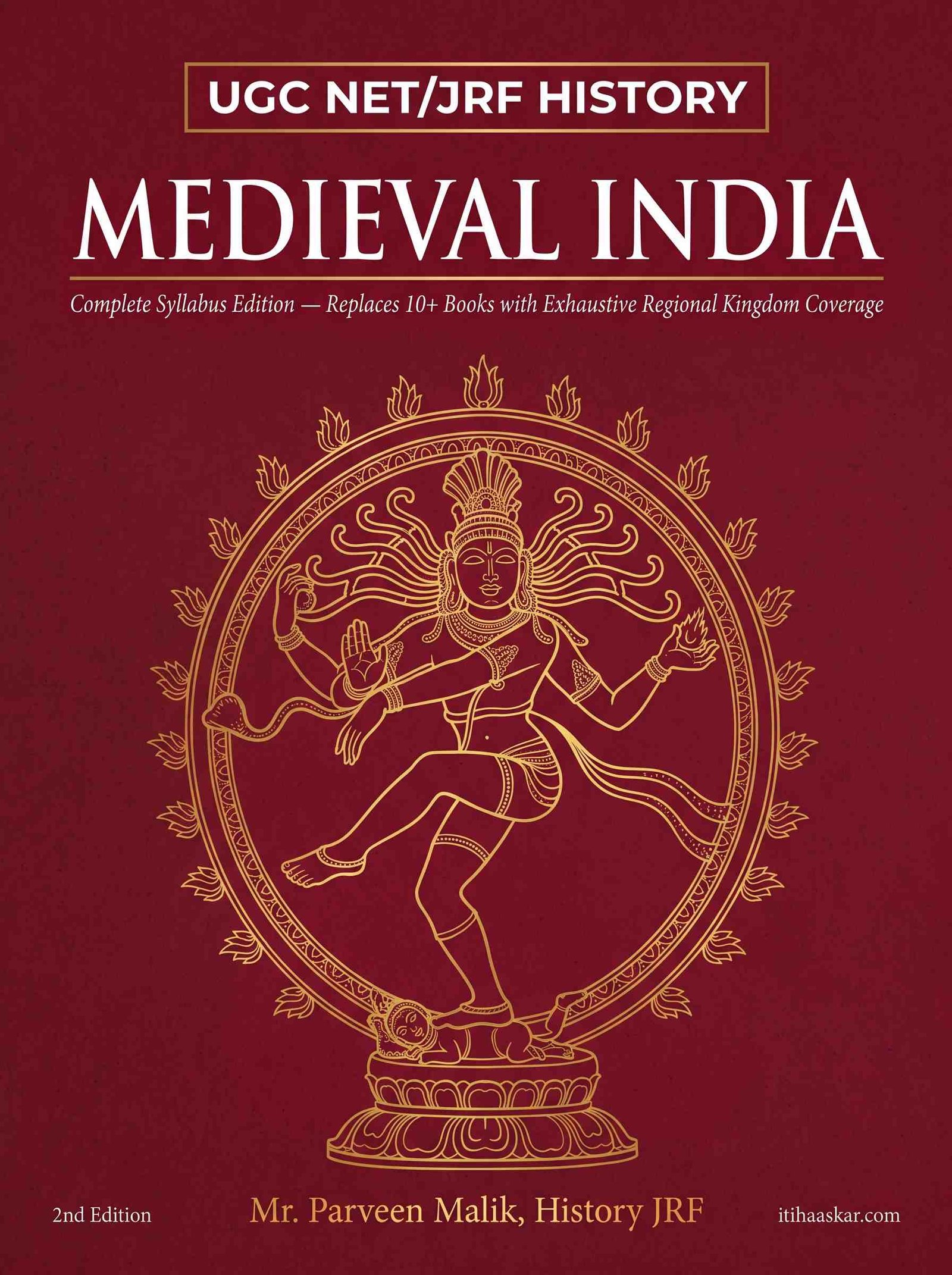
UGC NET Medieval India Notes PDF (Latest Syllabus + PYQs)
- Succession lines flowcharted — Sultanate to Mughals, no more tangled family trees.
- Revenue and administrative systems tabled dynasty by dynasty, exactly how the paper compares them.
- Bhakti–Sufi movements mapped era by era, so you never mix up which saint belonged where.
- The single most-tested block in the whole NET syllabus — finally organised so it sticks.
Complete Chapter List — 15 Chapters
- 1Sources of Medieval India
- 2Rajputs & Turkish Invasions
- 3Delhi Sultanate Politics
- 4Delhi Sultanate Administration
- 5Delhi Sultanate Economy & Society
- 6Bhakti Movement
- 7Sufi Movement
- 8Vijayanagara & Bahmani Kingdoms
- 9Mughal Empire Politics
- 10Mughal Administration
- 11Mughal Land Revenue
- 12Mughal Society & Culture
- 13Rise of the Marathas
- 14Decline of the Mughal Empire and the Rise of Sikh Power
- 15Appendix — Medieval India Reference Compendium
See a Free Sample Before You Buy
Read sample pages from this unit right in your browser.
Frequently asked questions
Do these notes cover Mughal administration in depth?
Yes — Mansabdari, Jagirdari, the central/provincial machinery, revenue systems and Sher Shah’s reforms are covered in detail, as these are the highest-weightage Medieval topics.
Are the notes available in Hindi?
Yes — English and हिंदी, switchable with the toggle above, which also sets your purchase language.
Is Medieval India useful for UPSC History optional?
Very — the Sultanate, Mughal and Maratha content maps directly onto UPSC History optional Paper I.
Does it include the Bhakti and Sufi movements?
Yes — both movements, their saints and their socio-cultural impact, as they are frequent PYQ topics.
What Medieval India students say

“The Historiography module finally made the Annales and Subaltern schools click for me. I cleared JRF in my very first attempt, and these notes were a big part of why.”
“Main abhi M.A. History second year mein hoon. Ye notes semester exams aur NET dono ke liye ek solid base de rahe hain — alag-alag jagah se padhne ki zaroorat hi nahi padti.”
“Ancient India was my weakest area for two attempts. The way the sources and historiographical debates are laid out here made it my strongest section in the actual paper. Cleared JRF this time.”
“Abhi NET ki taiyari kar raha hoon. Pehli baar Historiography aur Art & Culture jaise tough sections bhi manageable lag rahe hain. PYQ tagging se saaf pata chalta hai kya zaroori hai.”
“Hindi medium se hoon, par kabhi dikkat nahi aayi. Hindi notes ke terms bilkul clear the. NET qualify kiya, ab JRF ki taiyari kar rahi hoon inhi notes se.”
“Bundle liya tha — har rupaye ka paisa vasool. Coaching ke handouts se kahin zyada organised aur deep hai. JRF author ka farak saaf dikhta hai. NET aur JRF dono cleared!”
Studied with Itihaaskar? Share your experience
Log in to leave a review and help other aspirants choose with confidence.
Log in to leave a reviewYour complete Medieval India toolkit
Everything to study, revise and practise Medieval India — in one place.